
Launch of the Europe Sustainable Development Report 2026
The UN Sustainable Development Solutions Network (SDSN) has just released the seventh edition of the Europe Sustainable Development Report (ESDR 2026) and there is a clear message: Europe’s progress on the SDGs has stalled.
With less than five years to go until 2030, the report finds that momentum has slowed across the region, and in some cases, progress is even reversing. No European country is currently on track to achieve all 17 SDGs.
Prepared by the SDG Transformation Center at SDSN in partnership with the European Economic and Social Committee (EESC), the 2026 report assesses 41 countries including all EU Member States, Candidate Countries, EFTA countries and the UK. While several European countries continue to rank highly overall, serious challenges remain.
Environmental pressures are mounting, particularly around climate action, biodiversity, sustainable consumption, and agriculture. At the same time, the report highlights worrying social trends. Its Leave-No-One-Behind Index shows rising material deprivation in a number of countries that traditionally perform well, with Ireland and the UK ranking 7th and 21st, respectively.
The ESDR also calculates a Spillover Effect Index which estimates the impact of nations beyond their geographic borders, e.g., greenhouse gas emissions or air pollution embodies in the imports consumed. For this index, Ireland and the UK ranking 27th and 22nd, respectively. It also notes that around 40% of the EU’s greenhouse gas emissions are generated abroad through trade — a reminder that Europe’s global footprint remains significant.
The report also points to a decline in political prioritisation of the SDGs at EU level, with fewer references to the 2030 Agenda in recent European Commission work programmes. In a context of growing geopolitical pressure and declining public trust in government in some countries, this weakening commitment is a cause for concern.
A foreword by Ambassador David Donoghue, former Irish Permanent Representative to the UN and Co-Facilitator of the SDGs, highlights the importance of renewed EU leadership and a clear recommitment to sustainable development. David also chairs the Executive Committee of SDSN Ireland.
Importantly, the ESDR 2026 does not just diagnose the problem, but it also sets out practical, science-based pathways to get back on track. From clearer financing strategies and fairer agricultural emissions targets to stronger policy coherence and cross-sector collaboration, the tools are there.
As the EU begins shaping its 2028–2034 budget, the report argues that this is a pivotal moment. Europe has an opportunity to reaffirm its global leadership on sustainable development — but doing so will require renewed ambition, accountability, and political will.
The full report and interactive dashboards are available via SDSN
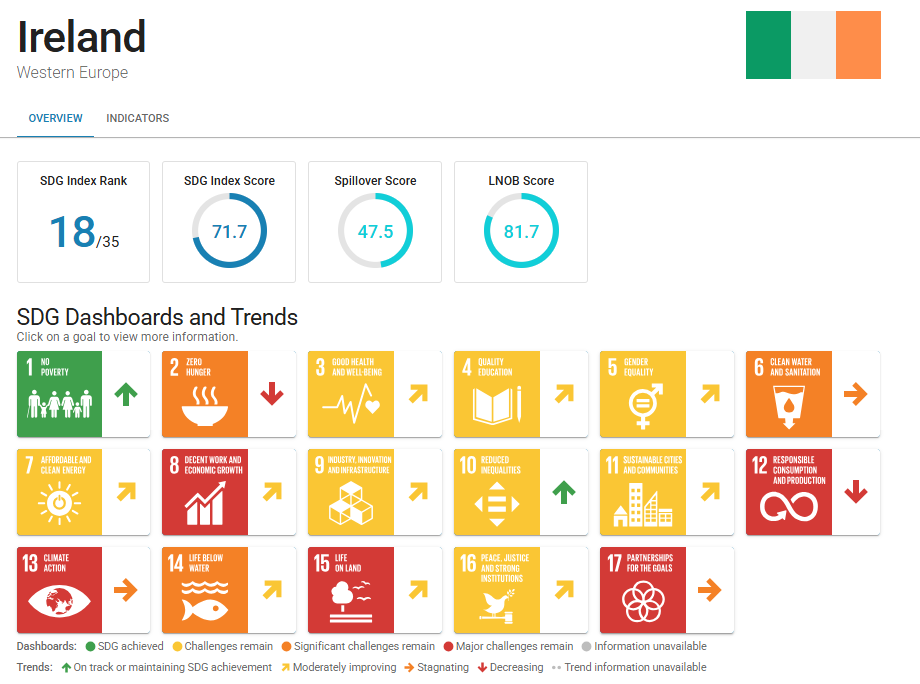
Summary Scorecard on SDG Implementation in Ireland
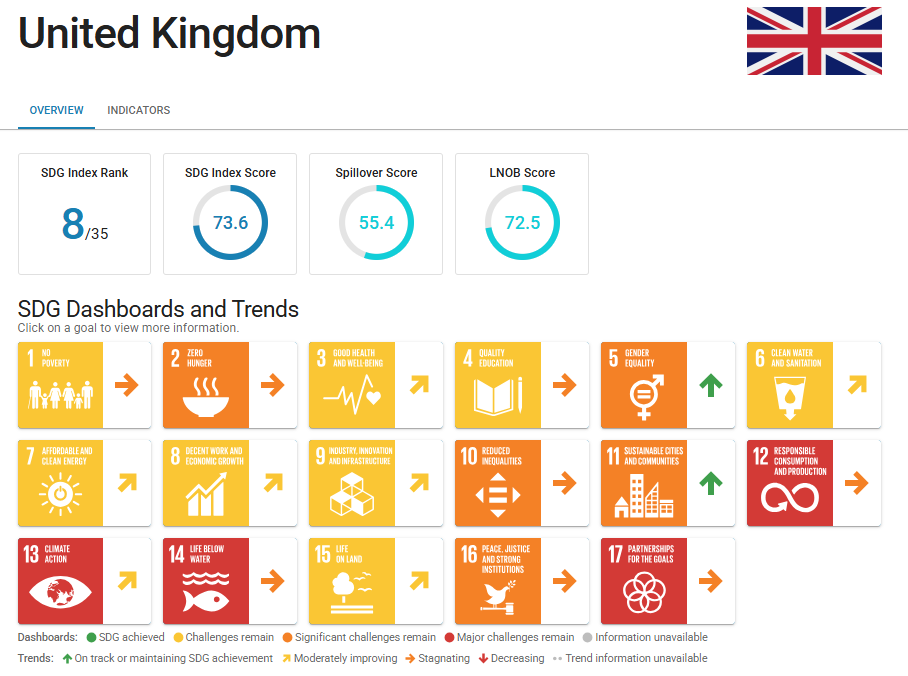
Summary Scorecard on SDG Implementation in the United Kingdom